
The Business Case Isn't the Decision
What execs are really weighing when you leave the room


Note from Nick: A lot of what I write about here is focused on the front end of the value conversation: how do you quantify the financial impact of data work, and how do you put together a business case that’s actually compelling? But I don’t have as much experience on the part that happens next - i.e. what goes on behind closed doors after you’ve presented that case. The politics, the trade-offs, the decision-making that you’re rarely in the room for.
That’s exactly why I asked James Miller to write this guest article. James is a former CDO and now Director at Anmut, so he’s been on both sides of the table - building the case and being the person who decides on it. His piece covers what executives are really weighing up when your proposal lands on their desk, and why a strong business case is often the beginning of the conversation, not the end.
The Business Case Isn’t the Decision: What Execs Are Really Weighing When You Leave the Room
by James Miller (author of The Data Boardroom)
You’ve just delivered the perfect pitch for your data project. The ROI is clear, risks are mitigated, the timeline realistic. Your exec sponsor nods thoughtfully.
“Let me think about it,” they say.
Three weeks later: tumbleweed.
Or worse - the project is approved, but with half the budget, a compressed timeline, and a jump-scare “co-ownership” arrangement with a team that wasn’t even in the room.
As data professionals, we’re trained to believe that good analysis leads to good decisions. Build a solid business case, quantify the value, demonstrate feasibility - and rational actors will make rational choices.
Right?
Well, any data leader bearing boardroom scars will tell you that’s not always how it works.
The business case is your opening gambit, rarely fait accompli. Once you leave the room, another conversation takes place- one where your carefully constructed ROI model is just one among many factors that may affect the outcome.
This article is about that hidden conversation: what execs are really weighing, why even strong business cases stall, and what you can do about it.
Three questions execs ask that you (may) never hear
Let’s be clear—we do need to demonstrate impact. A solid business case is the price of entry into any sensible boardroom discussion.
Yet while you’re presenting your case, execs are running parallel calculations about risk, politics, and organisational reality. Here are three examples.
1. “Does this help me or hurt me?”
This is a question few say out loud, but believe me, it’s one of the first filters every exec applies. People aren’t neutral evaluators. They have their own goals, performance targets, risk tolerance, and incentives.
They’re asking:
“Does this project advance what I personally care about? Or does it represent a risk I’m unwilling to carry?”
The calculus can be brutal:
Will this make me look good?
Does this move me toward my next promotion?
If it fails, does it damage my reputation?
Will it require spending political capital I need for something else?
I once delayed a significant data strategy project because the main stakeholder was an interim CTO. They didn’t want to commit to strategic changes as it contradicted their aim to keep the lights on and not rock the boat. It was a decision they wanted to leave to a new leader looking to make their mark.
As data professionals, we’re not just asking for budget. We’re often asking people to put their credibility on the line for something they may not fully understand or can’t verify is working until it’s too late.
Execs have wildly different risk tolerance for betting on data projects:
The one secure in their role with a strong track record is more likely to take a bet
The one who’s new and under scrutiny may need far more proof
The one who’s interim or planning on leaving is optimising for quick wins, not multi-year transformation
The one whose incentives are skewed so badly you can’t win - like the Sales Director whose bonus is so tied to their course of action, that little you can say will sway them (I’ve been there)
You need to understand what your sponsor is personally optimising for, because it probably isn’t exactly what the business case says. Are they trying to prove something to the CEO? Do they need a win before their annual review? Have they been burned by data projects before?
If your initiative doesn’t align with their personal incentives or creates unacceptable risk, your business case may wither on the vine.
2. “What am I not being told?”
Experienced execs develop pattern recognition about what gets left out of business cases. When everything looks perfectly aligned - no friction, no trade-offs, no difficult conversations - many get suspicious.
The savviest will be sniffing out what you’re not saying: Technical debt you’re creating elsewhere. Dependencies on overloaded resources. Assumptions about stakeholder cooperation that are, let’s be honest, optimistic.
One question I’ve heard time and again, often after the data leader has left the room:
“So, what’s the real reason this hasn’t been done before?”
I once proposed a reporting mechanism across a portfolio of shopping malls. Detailed proposal, locked-down ROI, comprehensive implementation plan. My mistake was not considering organisational memory of past attempts. As a new data leader, I didn’t have the full history.
The exec knew better. There was a history of major political resistance from regional directors that went unmentioned in the business case. The project got approved (after a humbling moment for yours truly) but with a mandatory three-month “stakeholder alignment” phase that basically doubled the timeline.
The key: proactively surface the uncomfortable truths. Execs trust people who tell them what could go wrong more than people who promise it won’t. They’ve seen enough sanitised business cases to know when someone’s hiding the messy bits.
3. “What trade-offs need to be made to fund this?”
Every yes is multiple nos.
Execs aren’t just weighing your project against other data initiatives. They’re thinking about organisational capacity - not just budget, but attention, political capital, the company’s finite ability to absorb change.
Your data initiative isn’t competing against other data projects. It’s competing against:
The sales team’s territory expansion the CEO promised the board
The product launch that’s already behind schedule
The cost reduction program the CFO needs to hit margin targets
The “quick win” that makes someone look good before year-end
I once saw a use case for predicting shopping behaviours (£4M value over three years, proven technology, passionate exec sponsor) get killed in committee. Why? Marketing made a more compelling case for a customer-facing app that needed the same time-limited technical team AND the CEO had already committed to it.
The predictive project had an objectively better business case. But it was competing in a portfolio-level game where promises had been made elsewhere.
You need to understand what else is on the table and how your initiative stacks up in the broader context. This goes way beyond the data portfolio.
Why your £2M ROI loses to their £500K project
The Execution Confidence Discount
Whether fair or not, many execs mentally apply a “delivery discount” based on your track record. It’s not just about expected value - it’s about the cost of failure and your own credibility/political capital.
I’ve seen significant data initiatives go unfunded in favour of projects with lower value but which the organisation believes are more likely to succeed.
Your credibility and track record are part of your business case, whether you include them or not. Data teams carry specific baggage here with a history of over-promising, obsession with tools over impact, underestimating change management, and “90% done” projects that never close the last 10%.
Data teams that present like service desks rather than business enablers tend to attract an unfortunate reputation.
Strategic Narrative Fit
Some projects just “feel right” because they align with the story leadership is telling.
CEO talking about “AI-first strategy” to the board? Your ML project gets a narrative boost. Company in cost-cutting mode? Even brilliant growth initiatives get deprioritised. New exec looking to make impact in their first 90 days? Small, fast projects trump optimal long-term plays.
As data leaders, we need to ask: how do our projects fit the story of the business today? Note: this story may well be at odds with stated business goals. It may even be at odds with what you’re expected to do.
There’s a Japanese concept called “reading the air” (kūki wo yomu) all about sensing unspoken cues, atmosphere, and group dynamics to understand what’s really expected. This is an advanced skill gained from repeated exposure to the business, but every data leader needs it.
Organisations move in a direction (which can change often), and initiatives that accelerate that movement have built-in momentum. The ones that don’t - even if objectively better- are swimming upstream.
Reversibility Bias
Execs favour decisions they can undo quietly if things go wrong.
A marketing campaign that flops? Stop spending. A data platform that fails? You’re stuck with vendor contracts, half-built infrastructure, and organisational scar tissue that makes the next data proposal even harder to sell.
This is why “pilot” and “proof of concept” get approved when “enterprise rollout” doesn’t. It’s not that execs don’t see the bigger value - they’re pricing in the option to cut losses.
Frame your initiative in phases with clear exit ramps. Show them how they can pull the plug without being locked into multi-year commitment. You’re making it easier to say yes, as well as safer, overall.
Playing the Game
Once you understand what execs are really weighing, you can address those concerns directly rather than hoping your ROI overwhelms them.
Make the risk conversation explicit. Don’t wait for execs to ask what could go wrong - tell them. Include a “what could go wrong” section in every business case. Not dry risk registers with traffic lights. Specific scenarios: “The biggest risk here isn’t technical- it’s getting regional sales teams to actually use this. Here’s what we’re doing to address that before we build anything.”
Understand personal stakes. You need to understand what people are personally optimising for. Ask them (diplomatically): What does success look like for you personally? What are you worried could go wrong? What else are you being measured on this quarter? I’ve said it a thousand times - data is a people business, whether we like it or not.
Position within the portfolio. Don’t sell your project in isolation. Show how it enables other priorities. Find a way into the boardroom (all the best CDOs have). Talk to people who attend board meetings. Ask: “What’s taking up most of the oxygen in leadership meetings right now?” Then position your initiative as an enabler of those priorities.
Build trust first. If you don’t have execution credibility, don’t ask for the big bet. Start with something small, low-risk, and high-visibility. Deliver it early. Communicate the win. Use that credibility to ask for something bigger. This is painful when you can see the big opportunity sitting right there. But trying to skip this step is why strong technical leaders stall at director level. Trust is the hidden variable in every business case.
Increasing your chances
Even when you do everything right, you might still get a no.
The timing is wrong. The political landscape shifted. Someone else’s project is more important. Or the exec team simply doesn’t believe your team can deliver, fair or not.
This isn’t a game you can win purely on merit.
Data professionals hate this. We’re trained to believe that good analysis leads to good decisions, that facts win arguments, that rationality prevails.
But organisations aren’t rational- they’re human. Decisions get made based on trust, politics, timing, risk tolerance, personal incentives, and factors you can’t fully control.
There is a maturity shift: Junior data leaders think their job is to build the perfect business case. Senior data leaders know their job is to understand the decision-making environment and navigate it strategically.
The difference is about being better at “reading the air,” building relationships, picking your battles, and knowing when to push and when to wait.
Once you stop expecting decisions to be purely rational, you can start playing the actual game. Build relationships that create trust. Demonstrate execution capability through small wins. Position your work within broader strategic priorities. Address the real concerns execs have, not just the ones they voice in meetings.
I get it. To the rationally minded, this may seem painfully political. But the most impactful data leaders have learnt how their organisations work and become effective within that reality.
The truth is that your business case is less about proving you’re right than helping execs make a decision they can live with.
The numbers matter. But they’re not the decision. They’re the starting point for a much more complex calculation about risk, trust, timing, and strategic fit.
PS: If you liked James’ guest article, you should definitely check out his Substack, The Data Boardroom!
In other news…
1: James also came as a guest in our DPM community webinar last week! The topic was related -but separate- to that of this article: Data as an Asset: From IT Artifact to Business Value.
If you’ve already joined our new DPM community platform on Circle, the link above will take you straight to the recording. If you haven’t joined yet, you can do so in less than 1 minute via this link.
2: I’ve become obsessed with Claude Code. I’ve accidentally built a personal operating system for myself (CRM, task management, knowledge management, workflow automation). And it all happened organically during one of my busiest months in years - this wasn’t some funemployment procrastination project 😆
I’ve genuinely never been more excited by AI, and I’ve been working in data science for the last ten years. It’s been thanks to the confluence of three things:
Claude Code working off local files unlocks so many more possibilities for reuse, automation, and self-improvement (the ‘self’ being Claude I mean - but me also)
Yes, the new models (Opus 4.5 & 4.6) have really been that much better than anything before (if you don’t believe me, here’s what Andrej Karpathy had to say last week)
Add Wispr Flow to all of the above and suddenly ‘10x productivity’ isn’t as sci-fi as I would’ve dismissed it a few months ago
I’ll be sending out some resources (tutorials, starter prompt, and sort of stuff) in the coming days. I’ll share these here too, but if you want to get an email specifically about it, leave your email here.
3: The Data & AI Product Management online community is growing. We haven’t officially launched yet, but over a hundred people have already joined. If you’re a data or AI leader looking for a space to talk strategy, value, and getting things funded -without the vendor noise- come and have a look. Join here.
Upcoming community webinars:
March 9: What does a Data Platform PM actually do? (with Anna Bergevin)
March 18: 50 Data Products in 4 Years: What DS Smith Got Right (and Wrong) (with Adrian Pinder)
March 26: EU AI Act Explained (with Hamish Silverwood)
Plus, I’m gradually getting us more and more perks and freebies:
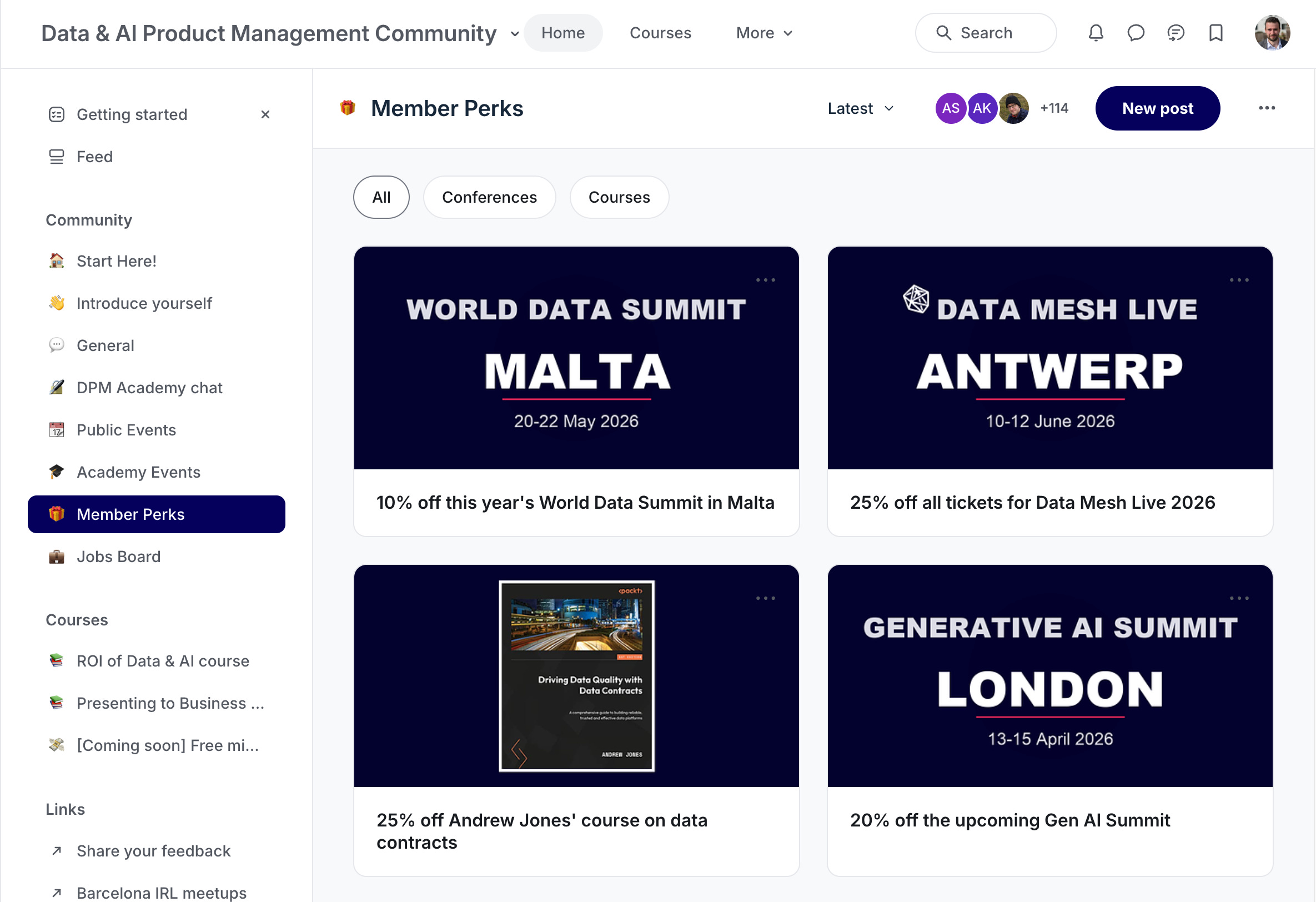
So, yeah. You should join! It only takes 30 seconds 👇
 | A guest post by
|
Hi James and other readers.
"Data professionals hate this. We’re trained to believe that good analysis leads to good decisions, that facts win arguments, that rationality prevails."
For a man to get a business case approved, just like any sale, the number one influencing factor is the credibility of the man making the sale.
Board members do not buy from men they don't trust.
The fact is that "data professionals" can not be trusted.
Trust is EARNED. It takes years to for a man to establish his reputation as an honest man of honour and integrity. It takes one lie to destroy it.
Men in the "data" area have destroyed their own credibility. Indeed, they have destroyed the credibility of honest men of honour and integrity like me. I have been tarred with the same brush as the snake oil salesmen.
In 2000 our airline, QANTAS, had their cargo division have a THIRD failed data warehousing project. The project manager was fired and the FOURTH project was given to a man with 20+ years in QANTAS Cargo. He was told if he failed he would be fired too.
So he called about 10 of his pals in the industry and explained his job was on the line with the new QANTAS Cargo Data Warehouse project. He asked his pals to please recommend who he should talk to for the project when it was his job on the line.
He was given my name FOUR TIMES and no other man was mentioned twice.
I eventually got the project. Why? The CEO and the senior managers trusted me because I EARNED their trust during the 8 week prototype phase. It did not hurt that 4 trusted advisors gave my name and said that if the project absolutely HAD to be successful they should hire me.
I was not surprised the prior projects failed. There were issues that were VERY complex. It was the toughest technical project I had done to that date. We actually had to invent new techniques to make it work.
It went on to be called "The most successful IT project QANTAS had ever run."
Indeed, during the interview process I gave the CFO an idea that he said was worth a couple of million dollars profit.
One thing that helped me earn credibility and trust was by giving them an idea saving them a couple of million dollars a year in the first two weeks.
When we did the demo at 8 weeks the CEO commented that I looked like I had been working there for 10 years. The CEO and senior managers were SHOCKED at my level of business knowledge of how the Cargo division worked in just 8 weeks. They could not believe my level of understanding of their business.
In short, when I asked for the $A1.7M budget I had EARNED their respect and their trust.
There is more to that story and I have published that.
The bottom line is that to get a million dollar plus "data project" budgeted the man presenting the business case has to be believed by those he is selling to. He has to be respected and trusted by the men voting on the decision.
Sadly, in our industry segment, men have focused on becoming better liars than becoming better at our profession.
After all? It is FAR easier to become a better liar than it is to become better at the "data" profession as it is so falsely called now.
Our industry segment is in a very sad state. Even my good friend Bill Imon has commented on this recently.
Hi James, and other readers.
The issue with "data projects" not being approved is not the above, though the above is all true.
The issue with "data projects" not being approved is that IT people in general and "data people" in general have zero credibility on the business side of the house.
Nor should they have any credibility.
We have managed our profession like a joke and so now "data professionals" are a joke on the business side of the house.
Not that long ago I was in a meeting with a CEO of a smallish company. She could see I was 60 years old and had long term experience. She was about my age. She asked me how it was possible for IT people to be so ignorant and so arrogant at the same time. She pointed out that most of her IT consultants would not know a debit from a credit.
I told her that 40 years of IT people telling themselves how smart they were while actually being very ignorant has led to a level of arrogance that was, frankly, embarrassing.
I told her that in the 90s I had tried very hard to promote honesty and hard work in my profession.
I told her that I tried very hard to have men take the position that we should name and shame the snake oil salesmen. I told her I failed and by 2002 I had given up. I just went about my business as best I could while snake oil salesmen got the majority of the attention in our profession.
And now? Every board member of every large company, every senior manager of every large company, knows full well that people in the "data area" are not to be trusted.
They know men like me exist in our segment, honest men, but they also know men like me are as rare as hens teeth and not even our own industry segment respects honest men of honour and integrity.
So they are not about to trust anyone in the "IT" area in general or the "data area" specifically, which is my area.
When the men in "data" want to be taken seriously by board members? They will take my advice that I have freely offered since the 80s.
Step one is "Be honest".
If a man in our segment is not even willing to be honest? Then I don't want to talk to him. I only want to talk to the very few honest men in our segment. Maybe they will take my advice, maybe they will not.
But any man presenting a business case for a "data project" should know that he is considered to be a "snake oil salesman" today by the men he is presenting to. And justly so.
Look at the failure rates of "data projects". Still over 50%. And we don't name the culprits. We let them go and commit other failures on other projects. We have no professional standards. We have less professional standards than plumbers.
Ok?